San Jose Bees (1962–1976): A Foundational Era at Municipal Stadium
The second incarnation of the San Jose Bees operated from 1962 through 1976 in the Class A California League and laid the groundwork for modern professional baseball in San Jose. They served as a farm club for the California Angels (1962–1969), Kansas City Royals (1970–1974), and Cleveland Indians (1975–1976). During those 15 seasons, the Bees produced championships, future Hall of Famers, and the attendance base that ultimately brought Triple-A baseball to the city.
They played at San Jose Municipal Stadium, the same ballpark that remains central to San Jose baseball today.
Immediate Success: The 1962 Championship
The Bees arrived in 1962 as an affiliate of the expansion Los Angeles Angels and wasted no time establishing themselves. The 1962 San Jose Bees finished 78–58 to win the California League pennant, scored 756 runs, allowed a league-low 679, and played under manager Red Marion.
San Jose defeated the Reno Silver Sox four games to three to capture the league title.
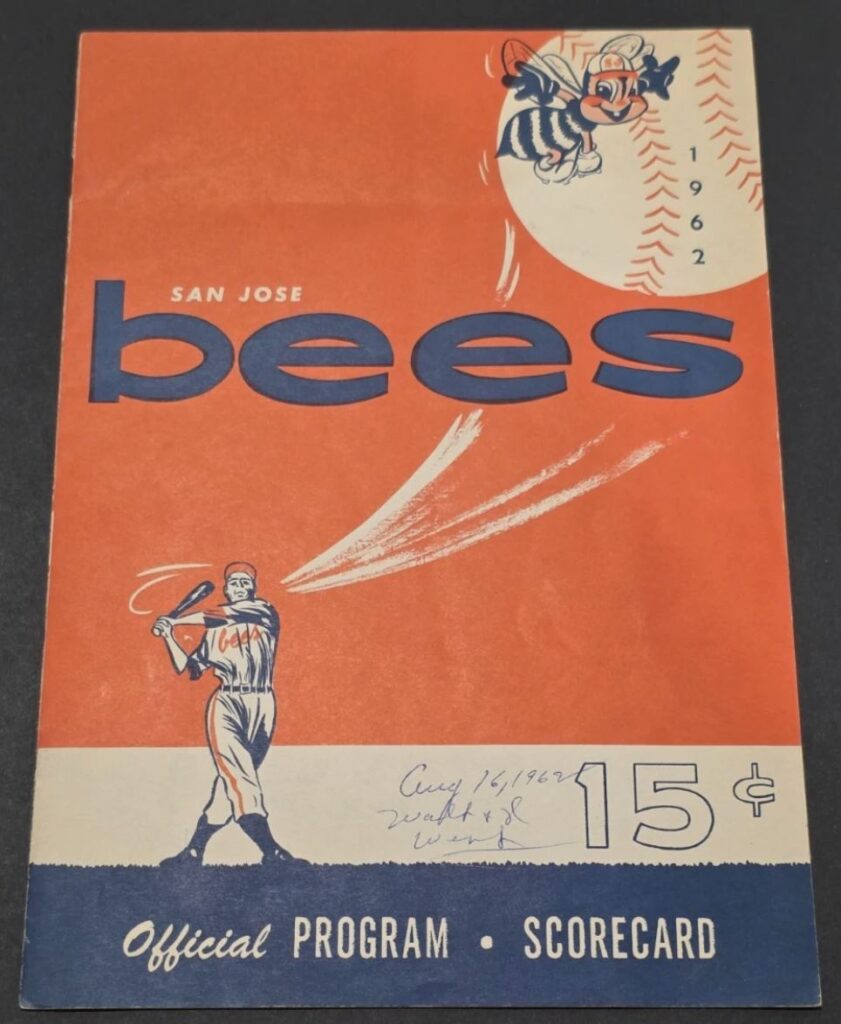
The offense revolved around Dick Simpson, who crushed 42 home runs and drove in 113 runs while hitting .315. Ron Clark, Wally O’Neil, and Jackie Warner each added 15+ homers. On the mound, Fred Newman won 15 games, and Ramón Hernández posted a 2.93 ERA.
The roster featured numerous future major leaguers, including Simpson, Hernández, Ed Kirkpatrick, Bobby Darwin, Jack Hiatt, Ron Clark, Fred Newman, and others. The Bees immediately established themselves as a serious development stop in the Angels’ system.
San Jose won another California League crown in 1967 under the Angels affiliation, reinforcing their early dominance.
The Royals Years: A Development Pipeline (1970–1974)
When San Jose became a Kansas City Royals affiliate in 1970, the club entered its most important player-development era.
Many players who later formed the backbone of Kansas City’s 1980 and 1985 World Series teams passed through Municipal Stadium:
- George Brett (1972) – Hall of Fame third baseman
- Frank White (1972) – 5-time All-Star
- Steve Busby (1971) – Two MLB no-hitters
- John Wathan (1971–72)
- Dennis Leonard (1973)
- U.L. Washington (1974)
- Amos Otis (Royals system product tied to this era)
This stretch cemented San Jose’s reputation as one of the California League’s premier talent incubators. Scouts, front offices, and fans knew that legitimate future stars passed through the Bees’ clubhouse.

Attendance Powerhouse and a Turning Point
From 1971 through 1976, the Bees led the California League in attendance every season. That sustained support made Municipal Stadium one of the strongest minor league markets in the West.
Ironically, that success led to the end of the Bees’ first era.
In October 1976, the Triple-A Sacramento Solons relocated to San Jose after struggling in Sacramento’s multi-purpose stadium. The higher-classification franchise displaced the California League Bees. The new Triple-A team adopted the name San Jose Missions beginning in 1977.
San Jose briefly left the California League before returning in 1979, beginning the lineage that eventually leads to today’s San Jose Giants.
The Final Season: 1976
The Bees’ final season closed the chapter on the original club. The 1976 San Jose Bees went 45–95 to finish sixth in the California League, scored a league-low 639 runs, surrendered a league-high 910, and played under manager Gomer Hodge.
Angelo LoGrande led the club with 19 home runs. Dan Massari hit .314 and drove in 81 runs. John Arnold, Don Flanagan, and Daniel Skiba each won six games.
Despite the record, several players from the 1976 roster reached the majors, including Ron Hassey, Garry Hancock, Alfredo Griffin, Dennis Kinney, Dave Schuler, and Tom Brennan. Even in a losing season, San Jose continued producing big-league talent.
Legacy and Later “Bees” Revival
The Bees name returned from 1983 to 1987 when San Jose fielded an independent California League club famously nicknamed the “Bad News Bees.” That colorful chapter stood apart from the original affiliate era of 1962–1976.
The first Bees era, however, remains the most structurally important. It:
- Delivered two California League championships (1962, 1967)
- Produced dozens of future Major Leaguers
- Helped develop the core of Kansas City’s championship clubs
- Proved San Jose could support high-level professional baseball
- Directly paved the way for the arrival of Triple-A baseball in 1977